Wednesday, 8 July 2015

HOW BIG HOW BLUE HOW BEAUTIFUL...

 ...as Florence would say.
 
Whenever we need a quick escape, we usually find ourselves heading South and East, to that slightly neglected bit of Yorkshire where even the place-names are a bit odd and arcane; Buttercrambe, Wetwang, Thwing and Kelk (Little and Great). Almost exactly a year ago we ran away to Burton Constable Hall, trying to forget about how everyone else was obsessing about bikes. Last week the heat in Middle Yorkshire was the problem, 29 Celcius in our village - but much less at Bridlington.


The beach at Brid was cool enough, at 19 degrees, for a brisk walk
 
 
or even a run!


    Perched on the cliff-top is Sewerby Hall, tasteful and elegant, inside and out.
 
 
Recent refurbishment has involved loans of late Victorian furniture from the V&A Museum and quite a lot of Farrow & Ball colour combinations. It used to look like this, but inside these days it is a lot less cluttered and strictly "No Photography".


Four miles on up the coast we arrived, at last, at Flamborough Head.


Flamborough's wonderful Georgian lighthouse was built in 1806 after the loss of 174 ships off this coast during the previous 25 years. Its enclosed lamp has shone over the sea ever since.
 
This earlier lighthouse, built from chalk blocks, dates from 1673.
 
 
Here, on the damp cliff tops, we found Northern Marsh Orchids


and, in the sea, other creatures, besides us, recaptured their cool.
 
 
***
  

Thursday, 18 June 2015

JUNE 18TH - A BIT OF A SKIRMISH

 
"It's June 18th 2015," said Mr N, "Should we celebrate?"
"I certainly hope so!"
"200 hundred years since that great day."
"Well none of us is getting any younger, but that's a bit insulting."
"It's 200 years since England won the battle of Waterloo, dear."
 
"AND my birthday. Even though I'm a pacifist, I have an appropriate day out in mind. The Royal Armouries in Leeds have some interesting Waterloo stuff on show, including a painting of the battle by Lady Butler. I used to know a boy who wrote a book about her..."
" Very funny! And that "boy" will be a grizzled pensioner by now."
 
"Scotland Forever!" by Lady Butler.


The fantastic Waterloo Cartoon is part of the exhibition. This is a huge preparatory drawing for "The Meeting of Wellington and Blucher" by Daniel Maclise. It measures over 13 metres wide.
 
No cause for celebration
 
Outside there was to be a military parade...
 
 
...if only they could remove the bollards.


Here they go!


The afternoon ended on a jolly note.
 
***


Saturday, 13 June 2015

PASSPORT TO THE PAST

 
Or should that be, "Pafseport to the Past"
 
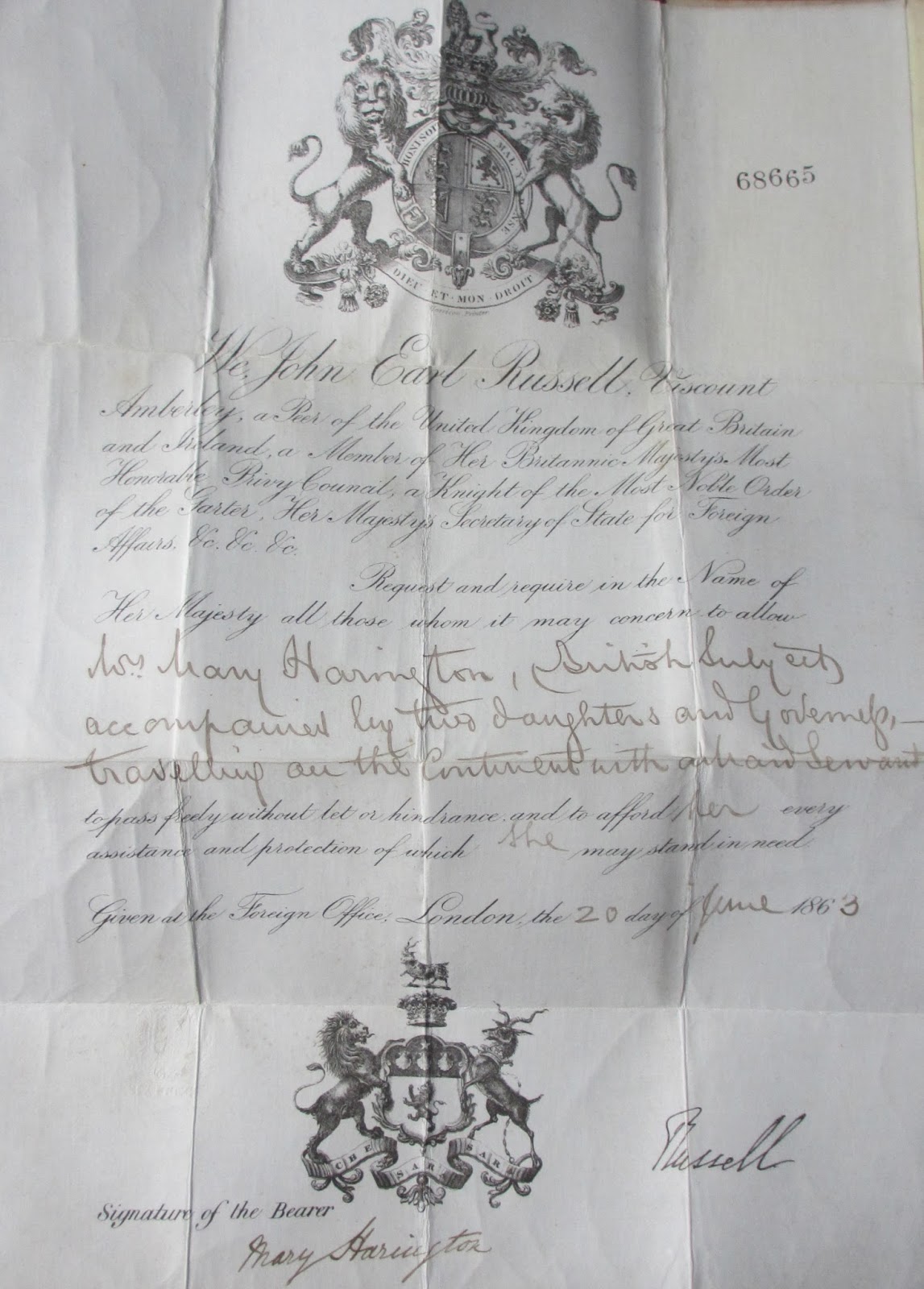
This Victorian passport, in the form of a red morocco leather notebook, stamped in gold with the owner, Mrs Harington's, name, was one of the treasures we found at the Wetherby Racecourse antiques fair this morning. No prizes are offered for guessing that I spent the afternoon glued to Google.
 
 
The passport is dated 1863, signed by Mary Harington herself and by the Prime Minister of the day, John, Earl Russell.
 
 
Mrs Mary Harington was travelling with her two daughters, a governess and a maid. First I looked at the 1861 census, hoping to find the right Mary. The fact that there were 735 of them did not stop my search - obviously a great number were too young, many were too old to have daughters who needed a governess - and many were simply too poor.
I found a widowed waistcoat-maker with a sister, but no children.
A Mary with two daughters - but her husband was a bricklayer and there were no servants.
Another had five daughters, all working as spinners in Kidderminster.
 
In the end there was just one possibility - Mary Harington, a widow aged 44 in 1861, with two young daughters, Beatrice Cecilia and Alice Margaret. They lived in Oxford in a household with servants. More googling revealed that Mary's husband had been the Reverend Dr Richard Harington, Principal of Brasenose College, Oxford until his death in 1853.
After the death of her husband, and her young son Robert two years later, Mary had not turned away from the world. One friend was Charles Dodgson, aka Lewis Carroll. In 1855 he wrote; " I made great friends with Mrs Harington's nice little children, Bob (who would die later that year) and Beatrice, 4 and 3 years old."
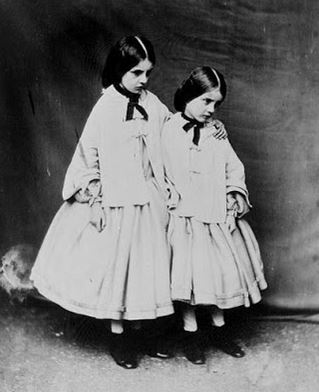
The friendship endured, he got to know the youngest girl Alice and yes, he took photographs...
 

Alice in 1859, aged 6.

 
Mary Harington died in 1886 and neither daughter married - but their names are remembered because of their devotion to the Settlement Movement. Oxford university men, with a strong religious belief in social change, began to work at providing housing and occupations for poor working men in the East End of London. Later there were settlements for women too. Beatrice and Alice left Oxford and devoted their lives to this cause at St. Margaret's House in Bethnal Green. 
 
                                      
St Margaret's survives to this day as a centre for community activities with a café and charity shop.
I still don't know where the Haringtons went with the small leather passport, but I have learned something about the road they travelled in life. Here is Beatrice's obituary from the Times in 1936. 


***
                                                          

Sunday, 31 May 2015

SUMMONSED TO COURT


My dear friend J had me worried for weeks. For one thing she had told me she was anxious herself, but she refused to explain what it was all about. "A surprise!" she said. It seemed it had something to do with a court appearance in the small market town of Otley in West Yorkshire. Saturday, May 30th was The Big Day.
 

This was reassuring, we were heading for Otley Courthouse, now a thriving arts centre. I'd been here before to the Film Club. As we approached, a vaguely familiar figure strode past me - I mumbled "Hello", anxious not to snub an acquaintance, even if old and half-forgotten.


(Dungarees! They're in vogue again - do you recognise her?)

J need not have worried  - this turned out to be a memorable evening! As Germaine Greer appeared on the small stage the applause was thunderous, increasing in strength and accompanied by whoops and cheers (Harrogate this was NOT!) None of us dared to take photographs of our formidable heroine, though I have found one tweet about the event:


Yes, "meandering but never dull" is a good description. Ms Greer's subject was "The Disappearing Woman" - with a short but lively question and answer session to follow. Sometimes she strayed from her main theme and talked about her present obsession, a tree-planting project in Australia. It is, she explained, vital to find something to feel happy, hopeful and positive about. The title of her talk could be taken to refer to one of her main concerns - a worrying imbalance between the birth figures for males and females. In China and India, for example, there appear to be 80 million missing females and large cohorts of surplus males. And figures are rising, the disparity is becoming bigger.


Another digression turned into a bit of a rant against the Guardian newspaper, accusing its journalists of failing to give enough coverage to women's issues or even to have the courtesy to name them. This point seems to be disproved by the photos above from recent editions of that publication and its sister paper, the Observer. Her complaints caused some shrill and understandably nervous questioning from a female Guardianista, with whom, I have to admit, I felt some unfashionable sympathy. 
The  evening ended with more applause and the encouragingly mixed audience, young and old and LGBT, wandered into the night with dreamy smiles on their faces, tinged with a little regret that the couple of times she had mentioned gays there was a hint of - what? Disdain? Disapproval? Perhaps it was because even she is an old lady now or perhaps we were mistaken. What the heck - we had met a legend! 
 
                                                        ***

Monday, 18 May 2015

MR N HAS HIS SAY

 
After the dramatic results of the recent General Election, Mr N (who has his own blog, "Arthur's Britain"), could not resist writing his version of the walk through a local bluebell wood that I described in my last post. I am publishing his account today, as a guest post. He has changed a few names (and facts) along the way...
 
POLLING STATION BLUES - TWO INVESTIGATIVE JOURNALISTS VISIT THE YORKSHIRE VILLAGE OF RUDFARLINGTON ON THE DAY AFTER THE GENERAL ELECTION OF 2015
 
      Following the disaster of yesterday's general election, Consuelo and I decided that we just had to find out if anyone in our Tory-dominated neighbourhood had actually voted for the Labour Party. In order to give ourselves a significant challenge, we chose to play our game of Hunt the Socialist in the quaint little village of Rudfarlington, still owned and dominated by the Inglenooks, an ancient landed family. I said to Consuelo as we parked the car:

      "I don't know what we're hoping to find here. I imagine every villager, every farm animal, garden flower and blade of manicured grass in this place is Tory!"

      "Lets just go and find out," she said.

      In the village square I spotted two actresses from the TV soap Emmerdale enjoying the spring sunshine. So, taking my life in my hands, I popped the question.

 
          Their relaxed approachability gave me confidence, and soon I found myself accosting and spying on everyone I encountered.


                At one point I thought we'd cracked it...
 
             
      ...but sadly not. Normal service was soon resumed.
 
 
      This place was so passionately Tory, you could almost see what people were thinking.
 

        "I suppose the difference between Tory voters and Labour voters," I said, "is that the Conservatives will move heaven and earth to get to the polling station."


      We were having no luck tracking down those elusive Labour voters, so we adjourned for lunch to the local pub, the Pheasant & Mantrap. The weather was fine enough to eat in the garden, where we struck up a conversation with a local shepherd - I say 'local', but he was obviously Scottish.
 
      "Och, aye" he said. "Quite a few people in the village voted Labour."

      "Where are they?" I asked. "We'd like to talk to some of them."
           
      "Ye'll have a job!" he said. "His lordship's decided to mak an example of 'em."
 
      "What on earth do you mean by that?" said Consuelo.

      "If ye gang up Ivybank Lane in aboot an oor from noo, jest beyond the lake, ye'll find oot."
      
      And that was all he would say on the subject, even though we invested significant quantities of Black Sheep ale and artisan shepherd's pie in him. I asked him which way he had voted, and he said this:


  "I can't believe that a working-class Scot like him went with the Conservatives," I said.

      "It just goes to show how out-of-touch the post-Blair Labour Party is with its core supporters," said Consuelo.

      After we'd finished lunch, we headed for Ivybank Lane and set up our cameras at the place he'd suggested to see if anything would happen. We waited for what seemed like ages, then just as we were about to pack up and go home, something quite dramatic kicked off:


      "What was all that shooting?" I said, the hairs still standing up on the back of my neck.
      
      "Clay-pigeons, I suppose," said Consuelo.

      Somehow, I was not convinced.

      "Clay-pigeons?" I said, with as much incredulity as I could muster without becoming embarrassing. "I'm not so sure about that! They sounded more like rifles than shotguns." 
      
      "So what do you think was going on?"
      
      "I'm just remembering what that shepherd said about local Labour voters..."

      "What did he say, exactly? I couldn't understand a word!"

      "I know it's a bit far-fetched, but is it possible that Rudfarlington has just been cleansed of all its socialists?"
      
      "You'll be telling me next that the helicopter we heard was attacking them with chemical weapons and barrel bombs."

      "I wouldn't put it past the Tories!" I said. "I have a theory that the landed aristocracy, which has been in political decline for well over a hundred years, has seen the chance to regain its power and position now that the Conservative party is dominated by upper-class Etonians. I mean, that shepherd seemed genuine enough. He wouldn't have said those things if they weren't true."

      "It was a wind-up, you idiot! It's a well-known trick: the country bumpkin outsmarts the sophisticated townie and gets loads of free beer and pies. Remember those films: The Maggie, Whisky Galore, Local Hero?"

      I thought about it for a few moments, then I said:

      "And all of them set in Scotland... You don't think the SNP are somehow involved in all this, do you?"

      "I wouldn't be surprised," said Consuelo. "Before the election, Nicola Sturgeon was alleged to have said that a Tory victory would be better for the SNP's cause - and she is a very determined and ruthless politician."

       "So if England was ethically cleansed of Labour supporters, it could help the SNP to achieve its aim of independence," I said. "It certainly makes you think." 

      "But if there's the slightest truth in it, the story's bound to come out," said Consuelo. "After all, we live in a liberal democracy protected by a free press."

      "I have just two words to say to that!"

      "And those two words are?"

      "Cyril Smith."
      
      "Okay, you've made your point."
      
      "Where was your beloved free press when he, and numerous others, were committing their crimes? The investigative journalists must all have known what was going on, but they chose to remain silent until the Establishment criminals escaped into senility or death."

      "I suppose you're going to blame Rupert Murdoch again."

      "The idea of him as a guardian of free speech and democracy is laughable! - I mean, what would be the point of us contacting News International with this incredible story? There'd just be another Establishment cover-up!"

      "Maybe..."

     "I know what I'll do!"

     "Nothing silly, I hope."

      "I'll blow this whole thing wide open on my blog!"

      "Nobody ever reads your blog. You recently set a new world record for the lowest number of hits ever achieved by anything that's ever been put on the internet...but unfortunately no-one noticed - not even those weirdos at the Guinness Book of Records."

      "But this story is far too big to be ignored. It has such a profound gravity - such critical mass - that's it's bound to go viral. This is the most sensational scoop since the Watergate scandal. It will be known the world over as 'Rudfarlingtongate'."

      "How delightfully the name trips off the tongue..."

      "I'm glad you like it." 

      "But one thing I did find quite curious," said Consuelo, "was the way everything went eerily quiet as soon as the shooting stopped?"

      "I noticed that as well," I said. "The birds stopped singing, and it got noticeably darker, even though there wasn't a cloud in the sky."

      "It was rather like an eclipse, I thought."

      "That'll teach Richard Dawkins to make smug remarks about the Pathetic Fallacy!" 

      "Anyway," said Consuelo, "let's not end with a negative vibe. I think we should go for a walk in Rudfarlington's renowned bluebell wood."

      "Okay," I said.

      And I was glad we did, for there is nothing more beautiful in all of England than a bluebell wood in the month of May, despite the unfortunate political connotations of the colour. And here, to prove just how beautiful it was, I present a very short video:

                                                 
      "More gunfire," said Consuelo. "I wonder what's going on."

      "You don't always get a clean kill with a firing squad," I said. "But hey, if the British people want to be governed by the Conservatives, then so be it. That's what democracy is all about."
 
      I took a few more photos as Consuelo drifted deeper into the wood. After a while I lost sight of her; but then I heard her voice carried on the warm spring breeze:
 
      "Come over here, Arthur," she said, "I think I've found what we're looking for."

      I joined her a couple of dozen yards away in a sunlit glade. She was pointing at the ground.
      
      "Look at that," she said. 

      Down at our feet, hidden in the grass, was a tiny, very delicate and vulnerable wildflower. 

      "I must get a photo of this!" I said, my spirits lifting for the first time since the election. 


      Then we spotted another one:


      "Perhaps there is hope after all," I said.

      Consuelo pondered my statement for a few moments; then she said:

      "Naaaah!"

      "Yeah, no, you're right," I said. "The country's going to be trashed, and this time the Bullingdon Club won't be picking up the tab."


      "Don't be too despondent, Arthur. Try to remain positive."
      
      "Shall we go home, now?" 

      "Yes, let's go home and have a nice cup of tea...and there's still some Eton mess in the fridge."

      "Not as much as there will be in this country after Cameron and his mates have finished with it!" I said.


      The Union Flag flew proudly over the crenelations of Rudfarlington Castle as we made our melancholy way back to the car park. 

      "The natural order has been restored," I said, with undisguised bitterness and irony. "The rich man in his castle; the poor man at his gate, as the song says. Feudalism is alive and well in twenty-first-century Britain."

      "Maybe David Cameron will be as good as his word and deliver one-nation Conservatism."

      "In your dreams!" I said. "Enoch Powell was right when he said that the Tiber would flow with much blood. But it won't be the blood of racial conflict - it will flow as a consequence of brutal and merciless cuts to welfare and the NHS."

      "I'm sure it won't be as bad as all that."

      "There's only one thing for it," I said. "We'll have to move to Scotland, the last bastion of socialism in these benighted islands."

      "No chance!" said Consuelo. "I don't find the SNP any more appealing than the Tories. And how can you trust a party whose leaders are all named after fish?"

      "That doesn't really make a lot of sense," I said. "It's the sort of thing people say to rationalise the fact that they've just voted Conservative... And please tell me you didn't. I couldn't bear it if I was the only socialist in the village." 

      In silence we retraced our steps along Ivybank Lane. Then, as the car park came into view I said:

      "Nicola Sturgeon has such an iconic and individual look, don't you think?"

      "A bit like an actual sturgeon."

      "She's quite attractive, in a Scottish sort of way. I wonder who her fashion consultant is..."

      "Someone she headhunted from the Crankies, by the look of it."

      "And like you said, she's extremely determined and ruthless - like a Scotch Margaret Thatcher."

        "Well, you've just blown it as far as moving to Scotland is concerned."

      "So it looks as if we're stuck with the Tories, then," I said. 

      "In perpetuity, I suspect," said Consuelo. "Especially once they've implemented all those constituency boundary changes they're planning."